
Cells & Services

Ready-to-Use and Custom Cell-Line Solutions

Research-use cell lines across porcine, bovine, and ovine species, with select products available now and others available on request. We also offer engineering services for teams working with customer-sourced cells.

Banked Cells

A catalog you can build on.

Porcine· 3 lines

Porcine · Fibroblast · Immortalized

Porcine Fibroblasts

Engineered porcine dermal fibroblasts for long-term expansion.
Porcine Fibroblasts
Porcine · ADSC · Immortalized

Porcine ADSCs

Primary porcine adipose-derived stem cells available for select research use.
Porcine ADSCs
Porcine · Myoblast

Porcine Myoblasts

Primary porcine myoblast / satellite cells available for select research use.
Porcine Myoblasts

Bovine· 3 lines

Bovine · Fibroblast · Immortalized

Bovine Fibroblasts

Engineered bovine dermal fibroblasts for long-term expansion.
Bovine Fibroblasts
Bovine · ADSC

Bovine ADSCs

Primary bovine adipose-derived stem cells available for select research use.
Bovine ADSCs
Bovine · Myoblast

Bovine Myoblasts

Primary bovine myoblast / satellite cells available for select research use.
Bovine Myoblasts

Ovine· 3 lines

Ovine · Fibroblast

Ovine Fibroblasts

Primary ovine fibroblast cells available for select research use.
Ovine Fibroblasts
Ovine · ADSC

Ovine ADSCs

Primary ovine adipose-derived stem cells available for select research use.
Ovine ADSCs
Ovine · Myoblast

Ovine Myoblasts

Primary ovine myoblast / satellite cells available for select research use.
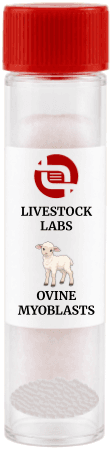
Ovine Myoblasts
Porcine · Fibroblast · Immortalized

Porcine Fibroblasts

Engineered porcine dermal fibroblasts for long-term expansion.

Description

A robust dermis-derived porcine fibroblast cell line isolated post-mortem (post-rigor) from a 6-month-old male pig sourced from an FSIS-inspected, USDA-regulated meat-processing facility in the United States. Donor animals were raised under an IACUC-approved protocol within an AAALAC-accredited program following Agriculture Guide standards, and tissues were collected and processed under institutional biosafety protocols into primary cells before cryopreservation.

The line was subsequently engineered via HDR-mediated targeted cassette integration, incorporating an immortalization factor and three pro-proliferative factors to enable long-term expansion and sustained growth performance. Cells are supplied frozen in a 1 mL cryovial (store in the vapor phase of liquid nitrogen; rapid thaw at 37°C recommended) and include a one-year research license.

A comprehensive documentation pack is provided, including donor and sourcing summary, characterization data, morphology images, long-term culture identity (karyotype and transcriptome PCA), recommended culture media, and storage/growth protocols, along with technical support for media optimization and process development; the license also includes ongoing media optimization updates and protocol refinements at no additional subscription cost.

For research use only, not for human or animal therapeutic use, diagnostic use, or consumption.

Characterization

Transcriptome PCA: early (P24) vs. late (P43) passage
Karyotype at passage 44
Long-term culture morphology, P25 to P40
Targeted cassette integration and factor expression

Specifications

Storage temperature
-150°C
Validation status
Research Grade
Cold chain class
Cryogenic (≤ -150°C)
Authentication method
Karyotyping, RNA sequencing, Targeted PCR
Cell count per vial
1 × 10⁶
Anchorage type
Adherent
Passage range
Confirmed up to 44
Primary vs immortalized
Immortalized
Tissue type
Connective Tissue
Mycoplasma status
Negative
Basal medium
DMEM, High Glucose
CO₂ percent
5
Biosafety level
BSL-2
GMO status
GMO
Breed
X-Bred
Species detail
Sus scrofa
Donor age
Juvenile
Donor sex
Male
Doubling time (hours)
28 - 41
Pathogen screening
Negative for common, rapidly growing, non-fastidious aerobic/facultative bacteria and common yeast.
Donor health status
Healthy
Recommended seeding density (cells/cm²)
500,000

Documents

Bovine · Fibroblast · Immortalized

Bovine Fibroblasts

Engineered bovine dermal fibroblasts for long-term expansion.

Description

A dermis-derived bovine fibroblast cell line isolated post-mortem (post-rigor) from a 21-month-old female donor sourced from an FSIS-inspected USDA facility. Donor animals were raised under an IACUC-approved protocol within an AAALAC-accredited program following Agriculture Guide standards, and tissues were processed into primary cells by an academic cell culture facility.

The line was subsequently engineered via HDR-mediated targeted cassette integration (LL020 cassette), incorporating an immortalization factor and three pro-proliferative factors, and has been maintained in long-term culture through passage 44. Cells are supplied frozen (store in the liquid or vapor phase of liquid nitrogen; rapid thaw at 37°C recommended).

Characterization data include growth performance (a mean population doubling time of 23 hours across six replicates), karyotype, transcriptome PCA and fibroblast-marker expression across early and late passages, and mycoplasma testing.

For laboratory research use only, not for human or animal therapeutic use, diagnostic use, or consumption.

Characterization

LL020 HDR cassette design and targeting
Genotyping PCR: GSH locus, 5′ junction and 3′ junction
Long-term culture morphology, P19 to P44
Population doubling time (six replicates) and cell density (replicate 2)
Karyotype at passage 44
Transcriptome PCA: early (P16) vs. late (P45) passage
Fibroblast marker expression, early (P16) vs. late (P45) passage
Mycoplasma test (MycoStrip 2.0): negative

Specifications

Storage temperature
-150°C
Validation status
Research Grade
Cold chain class
Cryogenic (≤ -150°C)
Authentication method
Karyotyping, RNA sequencing, Targeted PCR
Cell count per vial
1 × 10⁶
Anchorage type
Adherent
Passage range
Confirmed up to 44
Primary vs immortalized
Immortalized
Tissue type
Connective Tissue
Mycoplasma status
Negative
Basal medium
DMEM, High Glucose, with pyruvate
CO₂ percent
5
Biosafety level
BSL-2
GMO status
GMO
Species detail
Bos taurus
Donor age
21 months
Donor sex
Female
Doubling time (hours)
20.2 - 25.2 (mean 23)
Recommended seeding density (cells/cm²)
500,000

Documents

Genetic Engineering Services

We support teams from baseline characterization through multi-locus engineering, delivering cell lines ready for bioprocess evaluation.

Baseline characterization

Confirm identity and establish growth and differentiation behavior before any engineering work begins.

  • Identity & purity verification
  • Doubling-time and senescence profiling
  • Differentiation potential assessment

Targeted gene engineering

Targeted integration into genomic safe harbor loci for more predictable behavior and reduced random insertion effects.

  • Safe harbor knock-ins
  • Multi-locus trait stacking
  • Inducible / regulated expression

Trait builds & tuning

Introduce performance traits matched to your media and process constraints, then tune them iteratively.

  • Reduced media dependence
  • Maturation control
  • Lipid and texture optimization

Upgradeable architectures

Cell-line designs that support future modifications without rebuilding from scratch.

  • Versioned line registry
  • Re-entry sites for future traits
  • Long-term partner roadmap

QC & documentation

Sterility, mycoplasma testing, banking strategy, and partner-ready traceability, built in from the start.

  • Sterility & mycoplasma testing
  • Master / working bank strategy
  • Provenance and chain-of-custody records

Start a custom cell-line project

Tell us about your cells, media, process, and target traits. We’ll help map the right engineering path.